
Memories of a Soldier Settler’s Child
In 1951, my father went to Hamilton for two years to gain farming experience. Then in 1953, we moved to Flinders Island. Our first accommodation was a small two-bedroom, five-room hut in Whitemark, near where the golf club would later be. At that time, it was all bush.
I was five years old and don’t remember much about that first place, except that Dad used to drop us at school on his way to work. He was employed as a chainman for surveyors who were laying out the first 600-acre properties. There were no school buses then, so we walked home.
A couple of years later, we moved to Summer Camp. There were a few established Soldier Settlement farms, but we had to wait until ours was ready. We were one of only a few married families there. My first inkling of meeting people was the Bayles family who lived in one of the other married quarters at Summer Camp.
I became playmates with Leonard Bayles when we would have been 8 or 9. We became mates for many years after that until 1960 when I went to school in Launceston. I used to walk down to Leonard’s (Lot 2) and play cricket with him.
My strongest memories of Summer Camp are the dust, grease and oil, and the large machinery in the workshop, which made a big impression on me as a 7-year-old boy. We stayed there until our farm was ready.
Dad was allocated Lot 1, which had both hilly and flat country. By about the age of ten, I was driving a D2 Caterpillar tractor while Dad fenced long stretches of boundary on his own.
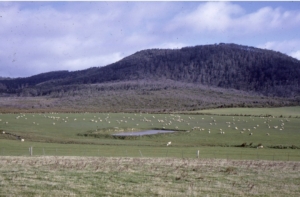
Lot 1 in 2019
The farm was built up gradually. We installed windmills, two 10,000-gallon water tanks and piping. Because of the hills, we could pump water up and then gravity-feed it to the stock. At first, we had no electricity—just Tilley lamps and a kerosene fridge.
Eventually all the mod cons came, we got our own generator, TV came along but best of all, we got hot water.
By 1958 we were all settled in, sheep and cattle, chooks, ducks and snakes everywhere. Dad ran Corriedale and Polwarth ewes, the latter for fat lambs and the Corriedale for wool. Both were crossed with Romney Marsh rams. Cattle were Aberdeen Angus.
At Summer Camp, Peggy Bayles drove my sister, Leonard and me to school for some years. Later, when more families moved onto their farms, a school bus was introduced. The roads were often a nightmare, and the bus would regularly get bogged in wet weather until gravel roads were put in where the sealed road is today.
I left the island at age eleven to go to boarding school in Launceston, which I absolutely hated. It was the worst 4 years of my life. I wish looking back that the school went to at least year 10, I hated going to Launceston to Boarding School. Rodney Blundstone was the only other person there from Flinders Island. We only came home in Xmas holidays and Easter break. The August holidays were at cadet camp. During school holidays, I helped Dad on the farm. I enjoyed that time and had my own horse, Prince.
Much of my time was spent helping on the farm. We were given daily jobs to do. Mine was to milk our cow, separate the cream from the milk for breakfast. The rest of the day was with Dad, and whatever chores he would give me. We learnt to make do. By the age of ten I was driving a tractor, and by twelve I was driving our old FJ Holden.
I don’t remember much about the very early days after we arrived, but I had the feeling we were not really accepted at first. Over time, friendships developed with other families, including the Matsons, Mainwarings, Patons and Browns, and with Dick Fowler and his wife.
As more farms were settled, there were more social activities. Around 1959 to 1962 (I can't remember the exact year) the Masonic Lodge was built. They put on a Xmas party for the kids. There were barbecues, dances at the halls at Whitemark and Emita. There was tennis at Whitemark, although we were not involved in that. There was also a yearly regatta at Lady Barron.
Flinders Island was a gift to a soldier settler’s child. As a mountainous island there were so many places to fish, swim and hike. I remember picnics at Trousers Point Beach, especially with the Gavin's, and often to Allports Beach with my parents. Dad and I went fishing at Port Davey jetty and for flounder at North East River for an early breakfast.
At 16, my parents had a long chat with me, the farm was too small for me and Dad, he was only 56 and had no intention of retiring. It didn't really worry me as I wanted to go to sea. I got my love of the sea going to Goose Island on the ketches to load sheep or cattle.
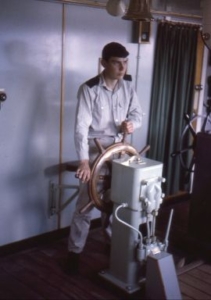
Ross, aged 16, on his first ship as a cadet
I joined the Australian National Shipping Line as a cadet officer (merchant navy) in 1964. I gained my first certificate in 1968 and completed further qualifications to obtain my master’s in 1974. I served as 3rd, 2nd and 1st officer on a variety of ships, travelling around the world, including through the Panama Canal, the Suez Canal and around the Cape of Good Hope. My last ship was a 160,000-ton iron ore carrier operating between Western Australia and Japan. I was very blessed with that period of my life at sea, seeing the world and getting paid for it.
In 1984, I left the sea as my family was growing up. I completed a diploma in business and worked for 21 years with a company in Sydney. I retired in 2013 and now live in the Blue Mountains.
Looking back, the life on the Island for a young soldier settler’s child was one of adventure, it was a pioneer start to a new life, a very free life with beaches, fishing, hiking all within 10 Kilometres of anywhere. It was very tough for the farmers, especially their wives.
I have been back to Flinders twice since I left in 1964. It is still one of Australia's hidden treasures ..... except for the bloody wind. 😊
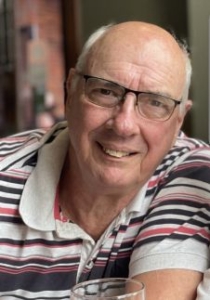
Written by Ross Dalgleish, April 2026