Lot 1 – Fairhaven
Jack and Enid Gunn
War Service Land Settlement Scheme

War Service Land Settlement Scheme

Farm gate memorial sign
John Gunn, originally from Launceston, Tasmania, was one of the early settlers at Fairhaven on Flinders Island under the War Service Land Settlement Scheme. A World War II veteran, he served with the Army for five years and was among the celebrated "Rats of Tobruk." In late 1953, he became the prospective settler for Lot 1 Fairhaven alongside his wife, Enid, a respected musician on Flinders Island.
The Gunns farmed their Fairhaven property for several years, although John’s poor health limited the pace and scale of operations. Despite these challenges, they remained part of the pioneering community that helped establish the settlement area. As the War Service Land Settlement Scheme progressed, their holding was later converted from temporary occupation to a permanent lease in the early 1960s. John Gunn spent the remainder of his life on Flinders Island, where he passed away.

soldier name etc
John Gunn’s military service is recorded as Army, with the service number xxxxx. Further details of his wartime service are still being researched and may be added as additional records become available.
| 1953 | John Gunn settled on Fairhaven Lot 1 |
| 1961 | Temporary lease changed to permanent lease |
Lot 1 Fairhaven was part of the Emita Estate.
Historical maps and current location images will be added as research continues. Lot boundaries, house sites and later property changes may require further verification.
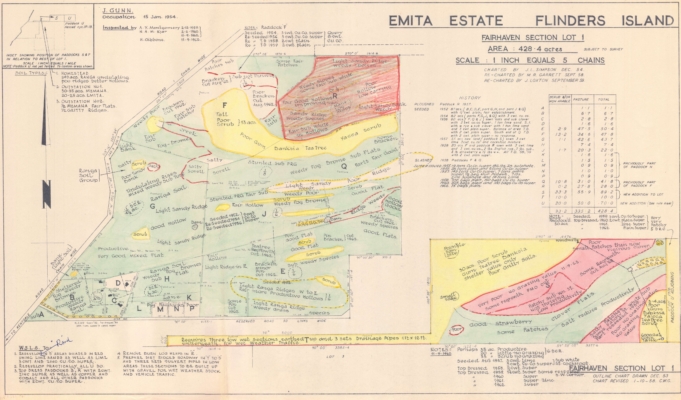
Photographs, maps, service records, family documents and newspaper items relating to Lot 1 Fairhaven are being collected.

The Furneaux Museum is continuing to document the history of each soldier settlement lot.
If you have photographs, family stories, military service records, farm records, maps, newspaper articles or corrections relating to Lot 1 Fairhaven, or its owners over time, we would be pleased to hear from you.
Your contribution will help preserve the history of the Soldier Settlement Scheme on Flinders Island.
Information on this page has been compiled from local soldier settlement records, family and community contributions, and ongoing research by the Furneaux Museum Soldier Settlement Scheme Working Group.
Some details may be incomplete or subject to correction as further information becomes available.